
The academic symposium "Enduring Silk Roads: New Discoveries and New Visions of Ancient Eurasian Continental Exchanges" was held on August 29th at the Chinese School of Classical Studies at Athens, Greece. Scholars from universities and research institutions in China, Hungary, the United States, Kazakhstan, the United Kingdom and other countries attended the event to discuss cross-regional civilizational exchanges across ancient Eurasia. Li Xinwei, Director of Chinese School of Classical Studies at Athens, stated in his opening remarks that it is hoped this symposium will serve as an opportunity to strengthen academic exchanges among scholars from different countries and regions and deepen understanding of interactions in ancient Eurasia from perspectives including archaeology and material culture studies.
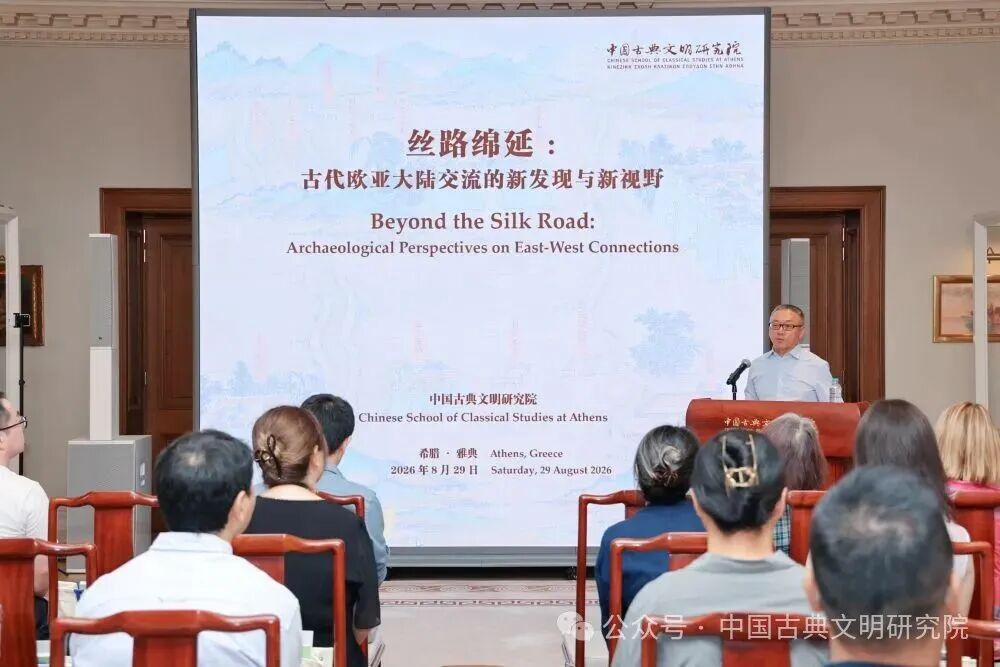
This photo taken on August 29 shows the venue of the symposium "Enduring Silk Roads: New Discoveries and New Visions of Ancient Eurasian Continental Exchanges" in Athens, Greece. Xinhua (Photo provided by Chinese School of Classical Studies at Athens)
The symposium revolved around two themes: "Pre-Silk-Road and Prehistoric Eurasian Exchange Networks" and "The Silk Road in Historical Periods — Interaction of Visual Arts and Material Cultures across Eurasia". Professor Liu Xinyi from the Department of Anthropology, Washington University in St. Louis, and Emeritus Professor Mark Pollard of Archaeological Science at the University of Oxford delivered keynote speeches respectively. Participating scholars discussed topics such as "prehistoric globalization", Neolithization in Central Asia, millet agriculture and environmental adaptation, sericulture and textile technology, the transmission and transformation of classical imagery, and civilizational exchanges along the Silk Road. Their discussions provided new archaeological evidence and research perspectives for further understanding of how Chinese civilization spread westward through the Silk Road, participated in Eurasian civilizational exchanges, and contributed to the development of world civilizations.
Krisztina Hoppál, archaeologist at Eötvös Loránd University (ELTE) in Hungary, said in an interview that the practical significance of studying the history of ancient Eurasian exchanges lies in the fact that exchanges, interactions and mutual influences between civilizations have always been an important part of human history. Historical experience can provide insights for dialogue, cooperation and mutual understanding among different civilizations today.
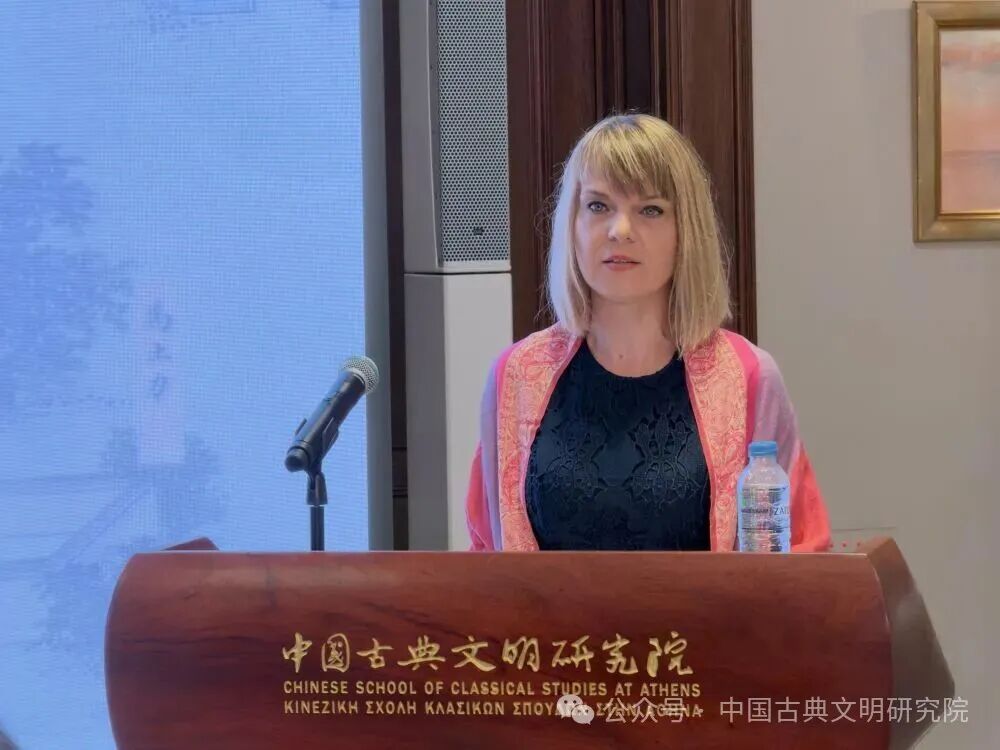
On August 29, Hungarian scholar Krisztina Hoppál spoke at the symposium. Photo by Xinhua reporter Liu Baiyun
As introduced, Chinese School of Classical Studies at Athens was founded in Athens in November 2024. It is committed to advancing comparative research on classical civilizations of China, Greece and Eurasia. Drawing on this platform, the symposium brought together scholars from multiple countries to promote deeper academic understanding of interactions among ancient Eurasian civilizations from diverse perspectives.