
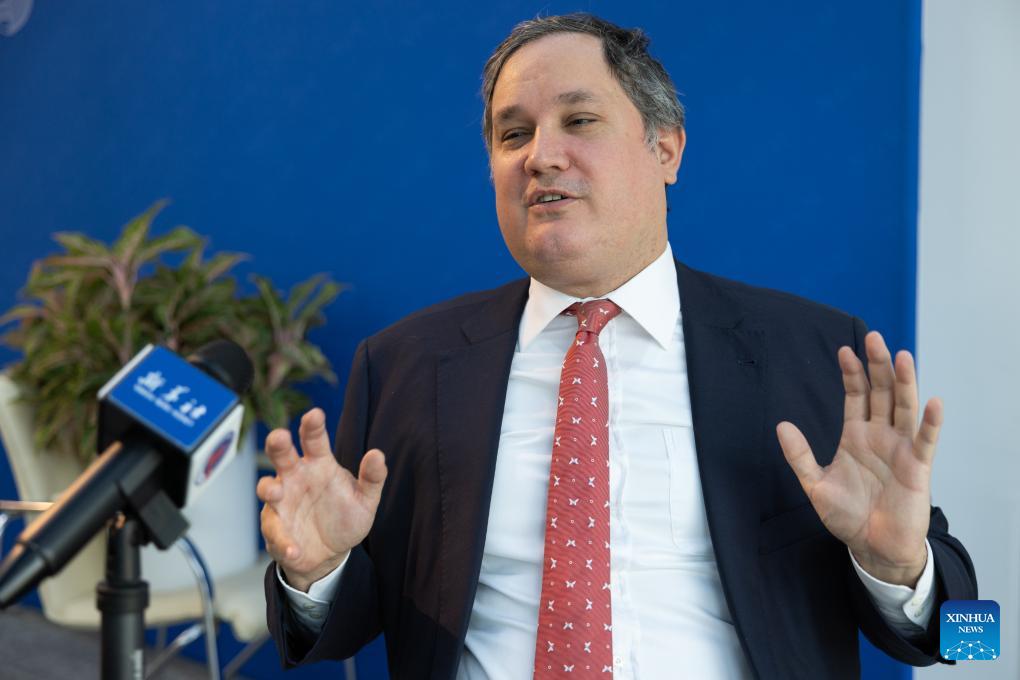
Hungarian Minister for National Economy Marton Nagy speaks during an interview with Xinhua in Budapest, Hungary, April 18, 2024. (Photo by Attila Volgyi/Xinhua)
BUDAPEST, May 4 (Xinhua) -- As the Belt and Road Initiative (BRI) gained fresh momentum last year on the occasion of its 10th anniversary, Hungary is looking forward to furthering its cooperation with China, a Hungarian official has said.
During a recent exclusive interview with Xinhua, Hungarian Minister for National Economy Marton Nagy said that the Hungarian side is looking forward to further cooperating with China in terms of foreign trade, capital investment, infrastructure, logistics, artificial intelligence, and new energy, among others.
The two countries have enjoyed a stable relationship, which is based on mutual trust and respect, Nagy noted.
He said that in 2023, Hungary was able to attract a total of 13 billion euros (about 13.86 billion U.S. dollars) in foreign direct investment, of which about 8 billion euros (about 8.53 billion dollars) were from Chinese investments.
Cooperation between Hungary and China in the financial field has also made great progress, he added.
He cited the example of the Bank of China, which has been present in Hungary since the mid-1980s and has chosen Budapest as its Central and Eastern European headquarters. In addition, many Chinese financial institutions have established or are about to establish branches or representative offices in Hungary.
Hungary is the first European country to sign a Belt and Road cooperation document with China. In recent years, the BRI has synergized more closely with Hungary's Opening to the East policy, enhancing bilateral practical cooperation in trade, investment, finance, and other areas.
Stressing the global significance of the initiative, Nagy said the BRI energizes global trade and economic cooperation among partner countries.
Hungary actively participates in the BRI, he said, noting that the Budapest-Belgrade railway, a flagship BRI project, not only benefits the two countries but facilitates the economic development of the entire region.
Citing China's robust economic performance, he said China's economic success is good news considering the Chinese economy's influence on the global economy.
China is on the right track based on its strategic thinking, he said, noting China's successful development of the electric vehicle (EV) ecosystem as an example.
By developing solar panels, charging stations, electric cars, and batteries simultaneously, China's strategic thinking is the reason for its success, he said.
Talking about China's EV industry, Nagy expressed concern over the ongoing anti-subsidy probe launched by the European Union.
"Now we fear that some countries might come up with the foolish idea to impose tariffs on Chinese electric cars," he said, noting that protectionism has always been a dead end.
"Protectionism is a bad path, especially in terms of electric cars," he said.
China's battery manufacturer Contemporary Amperex Technology Co. Limited (CATL) and EVE Energy, as well as EV maker BYD, have been working on production facility plans in Hungary.
The investment that came along with the rise of China's EV industry has been an opportunity, Nagy noted, adding that by giving space to Chinese companies, Hungary has become a hub for electric car and battery manufacturing.