
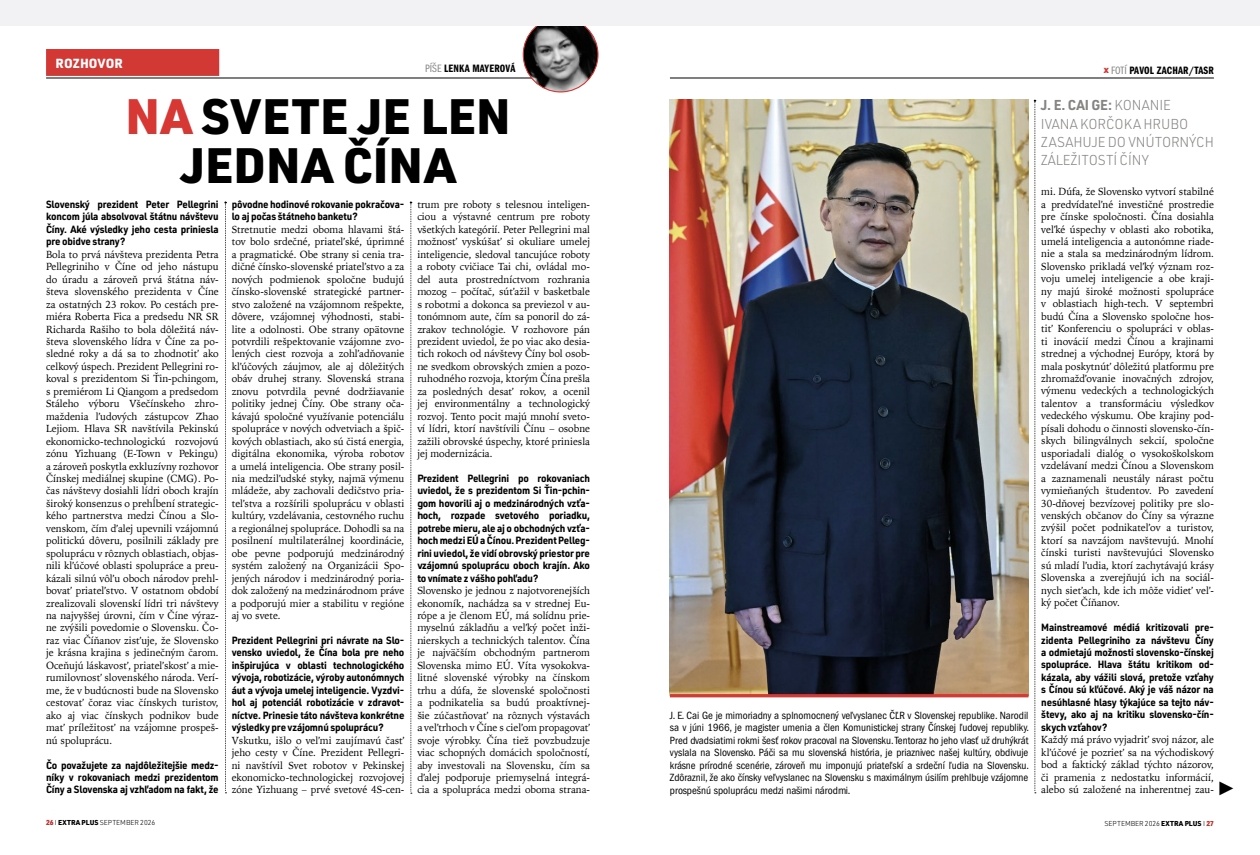
On Sept 3, 2026, Slovakia's ExtraPlus magazine published an exclusive interview with Chinese Ambassador to Slovakia Cai Ge. Ambassador Cai answered questions on Slovak President Peter Pellegrini's visit to China and China-Slovakia cooperation in trade, the economy, science, technology, and people-to-people and cultural exchanges. He also firmly rebutted erroneous remarks and actions by certain Slovak politicians. The interview attracted coverage from other Slovak media, including Public Affairs magazine. The full interview follows:
Slovak President Peter Pellegrini paid a state visit to China in late July. What results did this visit bring for us?
This was President Pellegrini's first visit to China since taking office and the first state visit to China by a Slovak president in 23 years. Following visits by Prime Minister Robert Fico and National Council Speaker Richard Raši, it was another important visit to China by a Slovak leader in recent years and was a complete success. President Xi Jinping held talks with President Pellegrini, while Premier Li Qiang and Zhao Leji, chairman of the Standing Committee of the National People's Congress, met with him separately. President Pellegrini also visited Beijing's Yizhuang Science and Technology Park and gave an exclusive interview to China Media Group.
During the visit, the leaders reached broad consensus on deepening the China-Slovakia strategic partnership. They further consolidated political mutual trust, strengthened the foundations for cooperation across a range of fields, identified priority areas for cooperation and demonstrated a strong desire to enhance friendship between the two peoples. I am confident that China-Slovakia relations will continue to improve in quality and reach new heights.
The three high-level visits by Slovak leaders in recent years have significantly raised Slovakia's profile in China. More and more Chinese people have come to know Slovakia as a beautiful country in Central and Eastern Europe whose people are kind, friendly and peace-loving. I believe that, in the future, more Chinese tourists will visit Slovakia and more Chinese companies will travel there to explore opportunities for mutually beneficial business cooperation.
It has been reported that the two heads of state attended a luncheon after their talks during President Pellegrini's visit. What do you consider the most important highlights of their meeting?
The talks were cordial, friendly, candid and practical. The two sides spoke highly of the traditional friendship between China and Slovakia and expressed their willingness to work together, under the new circumstances, to build a strategic partnership based on mutual respect and trust, equality and mutual benefit, stability and resilience. They reaffirmed their respect for each other's chosen development path and their commitment to accommodating each other's core interests and major concerns. Slovakia reaffirmed its firm commitment to the One-China Principle The two sides look forward to jointly exploring the potential for cooperation in emerging industries and frontier areas, including clean energy, the digital economy, robotics manufacturing and artificial intelligence. They will strengthen people-to-people and cultural exchanges, particularly among young people, carry forward their friendship, and expand cooperation in culture, education, tourism and at the local level. They also agreed to strengthen multilateral coordination, firmly uphold the international system with the United Nations at its core and the international order underpinned by international law, and promote peace and stability in their regions and the wider world.
After returning to Slovakia, President Pellegrini said he had been deeply inspired by China's achievements in technology research and development, robotics, intelligent driving and artificial intelligence. He also highlighted the potential for robots to be used in healthcare. The president was so impressed by his visit to the science and technology park in Beijing. Could you tell us more about it?
It was indeed a fascinating visit. President Pellegrini visited Robot Mall in Beijing's Yizhuang Science and Technology Park, the world's first 4S store for embodied-intelligence robots and a showroom featuring a full range of robot categories. Wearing AI glasses, he watched robots dance and perform tai chi, controlled a model car through a brain-computer interface, competed with a robot in shooting basketballs and took a ride in a driverless car. These immersive experiences gave him a firsthand taste of the wonders of technology.
In an interview, the president said that, on returning to China after more than a decade, he had witnessed firsthand the tremendous changes and remarkable development the country had achieved over that period. He spoke highly of China's environmental and technological progress. Many other national leaders have expressed similar feelings after visiting China: they have experienced for themselves the tremendous development achievements brought about by Chinese modernization.
After the talks, President Pellegrini said that he and President Xi Jinping had exchanged views on international relations, the breakdown of the world order, the need to maintain peace and economic and trade relations between Europe and China. He believes there is enormous scope for cooperation between Slovakia and China. What is your view?
Slovakia is one of Central Europe's most open economies and a member of the European Union, with a strong industrial base and a large pool of engineering and technical talent. China is Slovakia's largest trading partner outside the EU. China welcomes high-quality Slovak products into its market and hopes that Slovak companies and entrepreneurs will take a more proactive approach to participating in exhibitions and fairs in China to promote their products. China also encourages more capable Chinese companies to invest in Slovakia and further strengthen industrial linkages and integration between the two countries. We hope Slovakia will provide Chinese companies with a stable and predictable investment environment.
China has made tremendous achievements in robotics, artificial intelligence and intelligent driving, becoming a global leader in these fields. Slovakia attaches great importance to developing AI, and there are broad opportunities for high-tech cooperation between our countries. This September, China and Slovakia will jointly host the China-CEEC Conference on Innovation Cooperation. I believe it will provide an important platform for bringing together innovation resources, facilitating exchanges among scientific and technological professionals, and translating research results into practical applications.
Recently, the two countries signed an agreement on bilingual education and jointly held a China-Slovakia higher education dialogue. The number of students studying in each other's countries has been rising steadily. Since China introduced visa-free entry for Slovak nationals for stays of up to 30 days, business and tourist travel in both directions has increased substantially. Many Chinese tourists visiting Slovakia are young people who photograph its beautiful scenery and share it on social media, allowing more people in China to see the country's beauty.
I have noticed some differing views in Slovakia regarding this visit and cooperation with China. President Pellegrini has said that relations with China are crucial. How do you view these voices and the criticism of Slovakia-China relations?
Everyone has the right to express an opinion. What matters, however, is the motivation and factual basis behind it: whether it stems from a lack of information or entrenched prejudice; whether it rests on objective facts or deliberate fabrication; and whether it seeks to safeguard the shared interests of the country and its people, or instead serves partisan maneuvering or even personal political gain.
I wish to emphasize that, whether we take 1949 or 1993 as the starting point for diplomatic relations between China and Slovakia, China has never done anything to undermine Slovakia's national dignity or core interests. Today, China is a permanent member of the UN Security Council, the world's second-largest economy and a vast market of 1.4 billion people. Its science and technology are advancing rapidly, and it leads the world in many fields. It has become widely recognized internationally that working with China means embracing opportunities. High-level exchanges between China and Europe are very active. Since the end of last year, nearly 10 European heads of state and government have visited China. Practical cooperation between China and Slovakia has delivered tangible benefits to both countries and their peoples. China remains ready to continue deepening practical cooperation with Slovakia in all fields on the basis of mutual respect, equality and mutual benefit.
Some people claim that Chinese investment in Europe takes jobs away from Europeans and therefore worry that developing relations with China could harm Slovakia's interests. Others criticize China as autocratic and undemocratic. How do you respond to these claims?
On jobs, take Slovakia as an example. Across all Chinese-invested projects in Slovakia, there are fewer than 100 Chinese employees in total, mainly in management and technical roles. Yet these projects have created nearly 5,000 jobs for Slovakia.
On the second point, certain Western and Slovak politicians often display a rude, overbearing manner when talking about China, revealing obvious prejudice and outdated arrogance. Politicians should not behave like political thugs or street hooligans. At the very least, they should understand the need for mutual respect when discussing other countries. Human history stretches back millennia; national conditions vary greatly, and diverse civilizations coexist. What gives these politicians the right to dictate to other countries what constitutes democracy or dictatorship? The people of a country are best placed to judge whether its system works. Through long years of exploration and practice, the Chinese people have independently chosen a development path suited to their national conditions. This is their right, and outsiders have no standing to lecture them. China has always cherished peace, has never initiated a war against another country, firmly upholds international fairness and justice, and is committed to promoting world peace and common development. At home, China is pursuing high-quality economic and social development and has led its more than 1.4 billion people to achieve moderate prosperity in all respects, with a stable, peaceful and ecologically sound living environment. For many years, China has contributed around 30 percent of global economic growth, providing valuable momentum for global development. Polls by multiple international institutions show that Chinese public support for the Party and government has remained at around 90 percent over the long term, while favorable international views of the Chinese government have continued to rise.
Some politicians lack even a basic understanding of China's historical traditions and present-day national conditions. Some have never set foot in China, yet habitually follow the crowd and parrot others, readily making unwarranted accusations and judgments about China's internal affairs. This fully exposes their deeply rooted ideological obsessions and lingering Cold War mentality, as well as their own ignorance and narrow-minded prejudice.
A leading critic of President Pellegrini's visit to China is Ivan Korčok, Slovakia's former foreign minister and a vice-chair of Progressive Slovakia. He urged the president not to bring in Chinese investment and to follow the example of Poland and the Czech Republic by pursuing cooperation with both the Chinese mainland and the Taiwan region. Shortly after the president's visit, Korčok also traveled to Taiwan at the invitation of the Taiwan Institute of Economic Research to attend and address the "Ketagalan Forum". He held a number of meetings to support investment from Taiwan in Slovakia. What is your view?
The one-China principle is a broad consensus shared by the overwhelming majority of countries in the international community. It is also the political foundation for the establishment of diplomatic relations between China and Slovakia and for the development of our bilateral ties. The joint statement signed by the two countries in 2003 explicitly states: "There is only one China in the world, the Government of the People's Republic of China is the sole legal government representing China, and Taiwan is an inalienable part of China. Slovakia will continue to adhere to the one-China principle and will neither establish official relations nor engage in official exchanges with Taiwan in any form. Slovakia will maintain only private-sector-led trade and economic relations with Taiwan."
The so-called "Ketagalan Forum" is an event organized by the Democratic Progressive Party authorities. It deliberately draws in politicians from outside the region, hypes up the so-called "mainland threat" and peddles fallacies advocating "Taiwan independence". It seeks to enlist external forces to interfere in Taiwan Strait affairs in service of its scheme to seek independence by relying on external support.
Although Mr Korčok's actions do not represent the official position of the Slovak government, he has more than 30 years of diplomatic experience, served as Slovakia's foreign minister and has consistently professed support for developing China-Slovakia relations. He is well aware of the highly sensitive nature of the Taiwan question. Yet he blatantly visited Taiwan, lent support to "Taiwan independence" forces, met with "Taiwan independence" figures and even shared diplomatic experience with the so-called "Taiwan foreign minister". His actions seriously violate the one-China principle, grossly interfere in China's internal affairs, hurt the feelings of the Chinese people, undermine China-Slovakia friendship, damage the political foundation of our relations and poison the favorable atmosphere for their development. I am shocked by Mr Korčok's unprincipled conduct, which shows no respect for basic limits, and I firmly oppose it.
Korčok also said that Taiwan is a global "technology powerhouse" that could bring Slovakia many benefits, and that the examples of the Czech Republic and Poland show that Slovakia can cooperate with both the Chinese mainland and the Taiwan region.
First, it must be made clear that Taiwan has never been a country and never will be. Within the UN framework, Taiwan's legal status is that of a region of China. Any erroneous statement on sovereignty is a dangerous provocation. No one should play with fire on matters concerning China's sovereignty.
Second, China's position on the Taiwan question is consistent and clear: we firmly oppose official exchanges in any form, including those conducted under the guise of unofficial exchanges, between the Taiwan authorities and countries that have diplomatic relations with China. China's bilateral relations with the Czech Republic and Poland are both founded on the one-China principle. Actions that undermine this principle have damaged China's relations with both countries. In the late 1990s, China severed diplomatic relations with the country then known as Macedonia over a Taiwan-related issue. China has still not restored normal ambassador-level relations with Lithuania, which has also seriously violated the one-China principle. These concepts must not be deliberately conflated to mislead the public.
Third, assessments of the Taiwan region's economic, scientific and technological strength should be grounded in objective reality. Taiwan was once one of Asia's "Four Tigers", but its overall standing is no longer what it once was. In 2025, its GDP was equivalent to about 6.58 trillion yuan, or approximately $921.6 billion, accounting for only around 4.7 percent of the Chinese mainland's economy. It would have ranked seventh among the mainland's provincial-level administrative regions. Taiwan's performance in advanced semiconductor process technology owes much to its historically established first-mover advantage. In key future-oriented fields such as AI applications, mature-node semiconductor production capacity and digital economic competitiveness, the Chinese mainland has systemic and overwhelming strengths across the board. China is also the only country in the world with all the industrial categories in the UN industrial classification system, giving it a strong foundation for coordinated innovation across complete industrial chains. Those who ignore reality, deliberately mislead the public, seek publicity and manipulate words for personal political gain will ultimately find their actions backfiring.
Ľudovít Štúr, a pioneer of the Slovak national revival, once said: "Politics should serve the people, not personal interests." Deepening China-Slovakia friendship and advancing practical cooperation should benefit the peoples of both countries. We sincerely hope these efforts will not be reduced to a tool for partisan political maneuvering.