
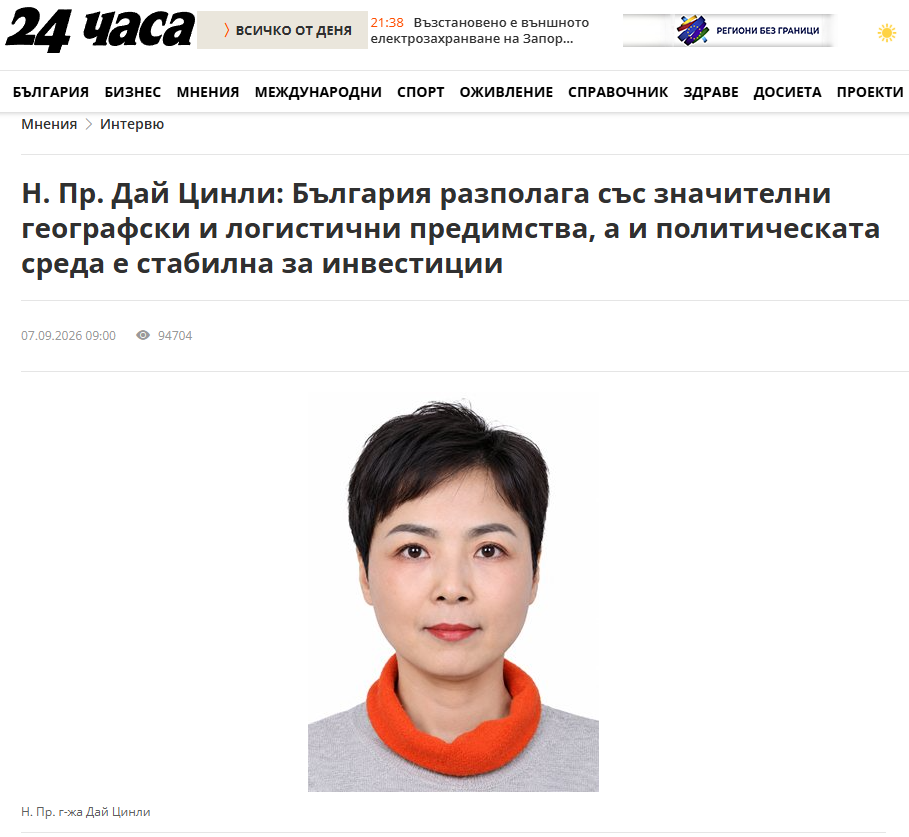
On Sept. 7, 2026, Chinese Ambassador to Bulgaria Dai Qingli gave a written interview to Bulgarian newspaper 24 Chasa. In connection with Bulgarian Deputy Prime Minister Poulev's visit to China, she outlined China's vision and expectations for the next stage of China-Bulgaria economic and trade cooperation. The full text follows:
1. Your Excellency, Deputy Prime Minister and Minister of Economy, Investments and Industry Alexander Poulev left for China on Sept. 6. What are the most important meetings and consultations scheduled during his official visit? Will the two sides sign any major agreements?
Dai Qingli: During his visit to China, Deputy Prime Minister and Minister of Economy, Investments and Industry Alexander Poulev will attend the 19th Session of the China-Bulgaria Intergovernmental Joint Commission for Economic Cooperation, to be held jointly with China's Ministry of Commerce. The session will discuss issues of practical economic and trade cooperation of common concern and advance efforts to establish a bilateral investment working mechanism. Deputy Prime Minister Poulev is also scheduled to attend exhibitions in the fields of investment and trade in services, take part in important official meetings, and hold a Bulgaria-themed country promotion event.
This is the highest-level economic and trade delegation to visit China since the current Bulgarian government took office. Deputy Prime Minister Poulev will lead a large, high-caliber delegation of officials and business leaders and will receive a warm and friendly welcome in China. This fully reflects the importance that both sides attach to the visit and their expectations for further developing practical cooperation. We hope and believe the visit will make an important and positive contribution to further consolidating the foundation of the China-Bulgaria strategic partnership, elevating bilateral economic, trade and investment cooperation, and advancing high-quality Belt and Road cooperation.
2. In early August, Deputy Prime Minister Alexander Poulev said during a meeting with you: "China is a strategic partner with enormous potential for investment, technological and industrial cooperation. We want Bulgarian-Chinese relations to develop on the basis of concrete economic outcomes—more investment, modern industries, new technologies and sustainable partnerships." Following your talks with him, how does China view the prospects for China-Bulgaria relations?
Answer: Deputy Prime Minister Poulev's remarks show that the new Bulgarian government regards practical economic and trade cooperation as a priority in developing bilateral relations and has sent a very clear signal of its willingness to cooperate with China. We welcome and appreciate this.
Bulgaria enjoys a strong geographical advantage and joined the Schengen Area and the euro area in succession last year and this year. It also offers the lowest tax rate among EU member states, a highly skilled workforce and favorable investment-promotion policies, making it attractive to Chinese companies. The formation of a regular government in Bulgaria has also created a more stable and predictable political environment for advancing China-Bulgaria practical economic and trade cooperation to a higher level.
As a Chinese saying goes, "The duck is the first to know when the river warms in spring." Since the Bulgarian government took office, many Chinese companies have visited Bulgaria to explore and discuss cooperation. In June, the Chinese Embassy in Bulgaria and the Confederation of Employers and Industrialists in Bulgaria jointly organized a series of China-Bulgaria trade and investment cooperation roundtables. Deputy Prime Minister Poulev held a face-to-face meeting with Chinese companies and addressed a roundtable attended by nearly 200 entrepreneurs from the clean energy, information technology, automotive, power and financial sectors of the two countries. Chinese and Bulgarian companies interacted extensively in a lively atmosphere, and many reached preliminary cooperation intentions. This clearly shows that China-Bulgaria cooperation is gaining momentum.
3. Do you believe China-Bulgaria relations have reached a substantive turning point since the government led by Prime Minister Radev took office? In your view, are the various processes between the two countries, particularly in the economic sphere, likely to accelerate significantly?
Answer: Since the current Bulgarian government took office, China-Bulgaria relations have shown sound momentum. In June, less than a month after the new government was formed, Chinese State Councilor Shen Yiqin led a delegation to Bulgaria. She met separately with Bulgarian President Yotova and Prime Minister Radev and held talks with Deputy Prime Minister Donev. The two sides reached broad consensus on further developing bilateral relations and practical cooperation.
This year marks the start of China's 15th Five-Year Plan. The continued advance of Chinese modernization will bring new development opportunities to countries in the region, including Bulgaria. China and Bulgaria have highly complementary industries and broad room for cooperation in many fields. First, as global energy security risks rise, new-energy cooperation is becoming increasingly important. Over the past three years, Chinese and Bulgarian companies have carried out extensive cooperation in solar power, energy storage and other areas. More than 90 percent of the energy-storage equipment installed in Bulgaria is made in China. Such cooperation has helped raise the combined share of solar power and energy storage in Bulgaria's overall energy mix to 20 percent, making the country a leader in power storage in Southeast Europe.
Cooperation on the electrification of public transport also has broad prospects. Bulgaria is above the EU average in this field. New electric buses from Chinese brands including Yutong and Higer have been introduced into local public transport networks in Sofia, Gabrovo, Vratsa, Veliko Tarnovo and other cities.
Second is cooperation in the automotive industry. Since the beginning of this year, five Chinese electric-vehicle brands—BYD, Chery, MG, XPENG and LINKTOUR—have actively expanded in the Bulgarian market and achieved strong results. Chinese companies have invested in automotive-parts manufacturing projects in Bulgaria. We hope the two sides will continue tapping the potential for cooperation in high-end manufacturing and the automotive value chain.
Third is infrastructure cooperation. Chinese companies have extensive experience in railways, roads, urban infrastructure and other fields. Exploring more flexible and diverse forms of cooperation would help both sides make full use of their respective strengths.
Fourth is agricultural cooperation. China is ready to continue expanding imports of high-quality Bulgarian agricultural products, and the two sides are advancing the relevant market-access procedures. Chinese technologies and products in smart agriculture and intelligent agricultural machinery can help Bulgaria improve agricultural productivity.
It is also important to note the strong demand and enormous potential for cooperation in tourism, culture, education, science and technology. We look forward to the early launch of direct flights between the two countries to effectively facilitate people-to-people exchanges.
Of course, turning sound bilateral relations and the desire for cooperation into tangible outcomes will require further concerted efforts by both sides. Against the backdrop of growing China-EU economic and trade frictions, China-Bulgaria economic and trade cooperation still faces practical constraints. We hope the Chinese and Bulgarian governments will maintain the momentum of high-level exchanges, strengthen dialogue, coordination and mutual trust, and foster a sound policy environment for companies from both countries to develop their businesses in each other's markets. We also hope companies from the two countries will strengthen communication, innovate cooperation models, actively explore new pathways for cooperation and achieve greater mutual benefit and win-win outcomes.