
Tougher regulations have recently been unveiled in China's major cities such as Shanghai, Shenzhen, Tianjin and Wuhan, to tackle some of the problems associated with the booming bike-sharing industry.
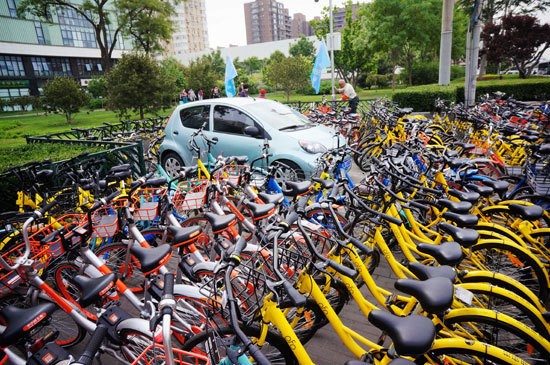
Rented bicycles from bike-sharing companies surround a private car.
They are designed to tackle such issues as indiscriminate parking, illegal cycling, deposit risks, and companies' deploying excessive bikes to expand their services.
In June this year, many provincial capitals such as Guangzhou, Nanjing and Hangzhou, also suspended the addition of new shared bikes on its roads.
Shanghai is the world's largest bike-sharing city, with over 1,500,000 shared bikes citywide, according to the city government. Last week it enforced a regulation requiring bike-sharing companies to remove excess bikes from certain roads.
A monitoring system has also been put into use around Shanghai West Railway Station to deal with nuisance parking. Bike users are rewarded for returning their bicycles to the proper place. Once a certain number of bikes is reached, the system informs staff to remove them.
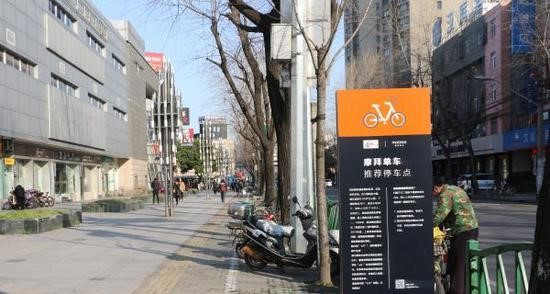
A recommended parking place in Zhenru town, Putuo district, Shanghai.
Zhenru town, in Shanghai's Putuo district, is trialing new technological means, such as electric fenced and geo-fencing, to help solve problems resulting from bike sharing.
Shenzhen has also joined the trend of reigning in the sector. The city has 10 bike-sharing companies operating around 890,000 bicycles. It requires companies to properly dispose of haphazardly parked bikes within 30 minutes, according to the Transport Commission of Shenzhen Municipality.
Wuhan, capital city of Hubei province, is to forbid bike-parking on certain road sections. Companies are to be restricted if their bikes are always parked in improper places.
Wuhan is also redesigning its slow lanes based on big data. Barrier facilities are to be set for non-motorized vehicle lanes to ensure riders' safety. Information on bike parking, borrowing and returning, credit rating, complaints, and suggestions are to be recorded by the government.
One industry insider has pointed out that, tougher regulations promote the section's orderly development. Li Xin, a Hubei manager of Mobike, one of China's largest bike-sharing companies, also says the regulations help use their existing bikes more efficiently as well as improve their company competitiveness.