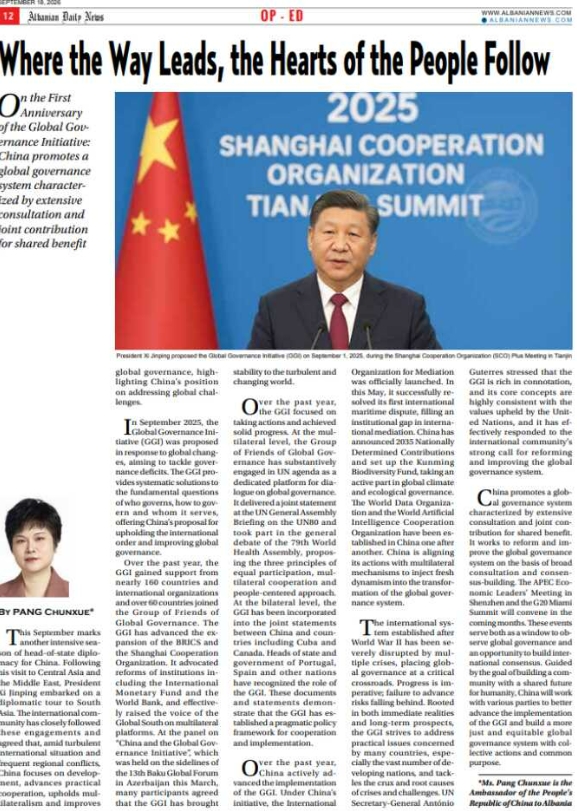
On September 18, Chinese Ambassador to Albania Pang Chunxue published a signed article titled The Way Forward: Unity of Purpose and Collective Will – Marking the First Anniversary of the Global Governance Initiative in Albanian Daily News, the most widely circulated English-language newspaper in Albania. The full text is as follows:
This September ushers in a busy new phase of Chinese diplomacy led by President Xi Jinping. Following landmark visits to Central Asia and the Middle East, the President embarked on a South Asian tour, drawing significant international attention. Amid global turbulence and escalating regional conflicts, China’s efforts remain focused on development-oriented policies, fostering pragmatic cooperation, upholding multilateralism, and advancing global governance. These efforts provide a steady and clear voice amid pressing global challenges.
The Global Governance Initiative (GGI), launched in September 2025, emerged as a timely response to the complex and shifting global landscape, addressing pressing governance challenges. The initiative provides systematic answers to key questions about global governance, such as who governs, for whom governance is conducted, how reforms should be carried out, and the direction governance should take. By presenting a comprehensive “Chinese solution,” the initiative aims to uphold the international order and enhance global governance mechanisms.
Over the past year, the GGI has garnered widespread support from nearly 160 countries and international organizations. More than 60 countries have joined the “Group of Friends for Global Governance,” contributing actively to institutional advancements such as BRICS’ expansion and the Shanghai Cooperation Organization’s enlargement, while advocating for reforms in institutions like the International Monetary Fund and the World Bank. In March this year, the 13th Global Baku Forum hosted a thematic seminar on “China and the Global Governance Initiative,” where participants from various countries affirmed the initiative’s role in fostering stability in an increasingly chaotic world.
Practical, action-oriented progress has been a defining feature of the initiative over the past year. Multilaterally, the “Group of Friends for Global Governance” has actively engaged in the United Nations (UN) agenda, delivering joint statements on the “UN80 Initiative” and participating in the general debate of the 79th World Health Assembly, (WHA) where principles of equality, multilateral cooperation, and a people-centered approach were emphasized. Bilaterally, the initiative has been mentioned in joint statements with countries such as Cuba and Canada, while heads of state and government leaders from Portugal and Spain have acknowledged its significance. These commitments have established a solid framework for pragmatic cooperation at the policy level.
China has been active in promoting the implementation of the GGI over the past year. It has proposed the establishment of an International Organization for Mediation (IOMed), which successfully resolved its first international maritime dispute in May 2026, filling a critical gap in global mediation mechanisms. China has also announced its 2035 Nationally Determined Contributions (NDCs) targets, established the Kunming Biodiversity Fund (KBF), and actively participated in global climate and ecological governance. Meanwhile, institutions such as the World Data Organization (WDO) and World Artificial Intelligence Cooperation Organization (WAICO) have been established in China, bringing fresh impetus to the transformation of the global governance system through concrete actions and multilateral integration.
At present, the international multilateral system established after World War II is facing multiple shocks, and global governance has reached a critical juncture where it must either forge ahead against the current or fall behind. The GGI, grounded in both current realities and long-term considerations, is committed to effectively addressing practical issues of concern to many countries, especially developing countries at large, and to tackling the crux and root causes of various crises and challenges. UN Secretary-General António Guterres believes that the GGI is rich in substance, that its core concepts are highly consistent with the convictions upheld by the UN, and that it forcefully responds to the international community’s strong call for reforming and improving the global governance system.
China has consistently upheld the vision of extensive consultation, joint contribution, and shared benefits in global governance, and has worked to reform and improve the global governance system on the basis of extensive consultation and consensus-building. In the second half of this year, the APEC meeting in Shenzhen and the G20 Summit in Miami will be held in succession. They will serve as both a window for observing global governance and an opportunity for reaching international consensus. Guided by the goal of building a community with a shared future for mankind, China is ready to work with all parties to better advance the implementation of the Global Governance Initiative and translate it into concrete action, overcome the current disorder through joint governance, pursue long-term goals through joint efforts, and steadily move global governance toward a more just and reasonable direction.