
On September 29, Li Fan, Chinese Ambassador to Bosnia and Herzegovina, gave exclusive interviews to FENA and SRNA, in which he answered questions on the first anniversary of the Global Governance Initiative, China-U.S. relations, China-Bosnia and Herzegovina relations, and international and regional hotspot issues. The interviews were widely reposted and positively reviewed by local media in Bosnia and Herzegovina. The main content is as follows:

Exclusive Interview with FENA
Question: On the first anniversary of the Global Governance Initiative put forward by President Xi Jinping, how do you assess its impact on international relations? In your view, what should China focus on in the next stage, particularly in bilateral and multilateral cooperation?
Ambassador Li: The international situation is at a critical juncture where crisis and opportunity coexist and war and peace stand in opposition, while risks from new challenges such as artificial intelligence (AI) security are on the rise. No country can resolve crises by acting alone, and global challenges call for a global response. In putting forward the Global Governance Initiative (GGI), China’s clearest message is to pool the strength of solidarity; its firmest position is to hold high the banner of multilateralism; and its most cherished vision is to pursue a future of fairness.
Ambassador Li: Since the beginning of this year, under the strategic guidance of President Xi Jinping, major-country diplomacy with Chinese characteristics has delivered many highlights. In the space of just one month, President Xi made three trips abroad: he visited Kyrgyzstan and Egypt and attended the SCO Summit, traveled to India for the BRICS Summit, and paid a state visit to the United States. These visits reached out to neighboring countries, engaged the Global South and advanced China’s overall diplomatic agenda, and China’s “circle of friends” has kept growing.
Ambassador Li: The exchange of visits between the Chinese and U.S. presidents within six months is of historic and milestone significance. At their Beijing meeting in May, the two presidents jointly affirmed the new positioning of a constructive and stable China-U.S. strategic relationship, making clear that efforts should be directed toward a relationship defined mainly by cooperation, with bounded competition, manageable differences and the prospect of peace. At their Washington meeting in September, they agreed to build a “constructive and stable China-U.S. strategic relationship based on respect, fairness and reciprocity,” providing clearer strategic guidance for the two countries to explore the right way for major countries to get along. This shows that the “Thucydides trap” can be transcended and that China and the United States can jointly find a correct path of peaceful coexistence. On the eve of the visit, the economic and trade teams of the two sides held a new round of consultations and reached a new joint arrangement, including establishing and advancing a Trade Council and an Investment Council, setting up an agriculture working group, reciprocal tariff reductions involving “US$30 billion,” and extending the outcomes of the Kuala Lumpur economic and trade consultations. The two sides agreed to support each other in hosting the APEC Economic Leaders’ Meeting and the G20 Summit, and the two presidents expressed their intention to attend the meetings hosted by the other. The improvement and growth of China-U.S. relations brings greater stability and certainty to the world.
Question: The world today is beset by wars and geopolitical divisions, and factors such as AI are posing new challenges. How realistic is the prospect of transforming the global governance system, and what role will China play in this process?
Ambassador Li: At present, the problem that the global governance system is ill-adapted and mismatched is more pronounced than ever. First, its authority is being eroded. The purposes and principles of the UN Charter have not been effectively upheld, and a handful of major powers have even “withdrawn from organizations and torn up agreements” or “cut funding and suspended contributions.” Second, its effectiveness urgently needs to be enhanced. Multilateral institutions have long suffered from deliberating without deciding and deciding without implementing, and some countries have failed to fulfill their due responsibilities and obligations. Third, its representativeness is seriously inadequate, as the representation and voice of the large number of developing countries are not fully reflected. UN Secretary-General António Guterres recently told the General Assembly that existing mechanisms for collective action are under growing pressure, and that global institutions still reflect the distribution of power and interests of an era that “has largely passed,” and therefore must be reformed.
Ambassador Li: A year ago, President Xi Jinping solemnly put forward the Global Governance Initiative, calling for upholding the purposes and principles of the UN Charter and practicing the vision of global governance featuring extensive consultation, joint contribution and shared benefits as the basic guide. It highlights five pillars of principles—sovereign equality, the international rule of law, multilateralism, a people-centered approach and action orientation—providing a systematic proposal for reforming and improving global governance. Over the past year, the GGI has built broad international consensus and quickly won the support and response of nearly 160 countries and international organizations. More than 60 countries have enthusiastically joined the Group of Friends of Global Governance and carried out intensive coordination on a wide range of global governance issues. The International Organization for Mediation began formal operations in Hong Kong, China, and successfully resolved its first international maritime dispute. The World Data Organization was established in Beijing. The World AI Cooperation Organization (WAICO) was established in Shanghai. China and the United States established an AI dialogue mechanism to exchange views on its risks and benefits and jointly prevent the abuse and malicious use of AI, with the next dialogue to be held this November. This autumn, China will host the Global Governance Forum in Xiong’an New Area, and guests from all sides are warmly welcome to take part.
Question: The situation in the Middle East and the war in Ukraine show how difficult it is to reach a political settlement in ongoing conflicts. Can China, through the principles and mechanisms of the GGI, make a more concrete contribution to resolving these two conflicts? How much room is there for it to play a mediating role?
Ambassador Li: The continued tensions in the Gulf and the Middle East are impacting global energy security, the geopolitical landscape and the international order. China has always held that the sovereignty and security of all countries must be respected, and it has consistently played a constructive role in easing the situation and cooling tensions, encouraging all parties to stick to the choice of peace and maintain the momentum of negotiation. China supports the United States and Iran in returning to the Islamabad memorandum of understanding, and hopes that the two sides will get back onto the track of dialogue and negotiation to resolve the issue at an early date and ultimately reach a comprehensive agreement covering the nuclear issue, so as to achieve peace as soon as possible. China is a builder of peace, a promoter of stability and a supporter of development in the Middle East. Force cannot solve problems; dialogue is the right way forward. Negotiations will not be accomplished overnight, but now that the door to dialogue has been opened, it should not be closed again.
Ambassador Li: China’s position on the Ukraine issue has been consistent and clear. It holds that the sovereignty and territorial integrity of all countries should be respected, the purposes and principles of the UN Charter should be observed, the legitimate security concerns of all countries should be taken seriously, and all efforts conducive to a peaceful settlement of the crisis should be supported. China is neither the instigator of nor a party to the Ukraine crisis. We will only do what is conducive to peace and remain committed to promoting peace talks. Over the past four years and more, China has maintained close communication with Russia, Ukraine and other relevant parties, sent special envoys to conduct shuttle diplomacy, and, together with Brazil and other Global South countries, initiated the Group of Friends for Peace on the Ukraine crisis, continuously building consensus for peace and advancing peace efforts. We stand ready to work with the international community to continue playing a constructive role in the political settlement of the crisis.
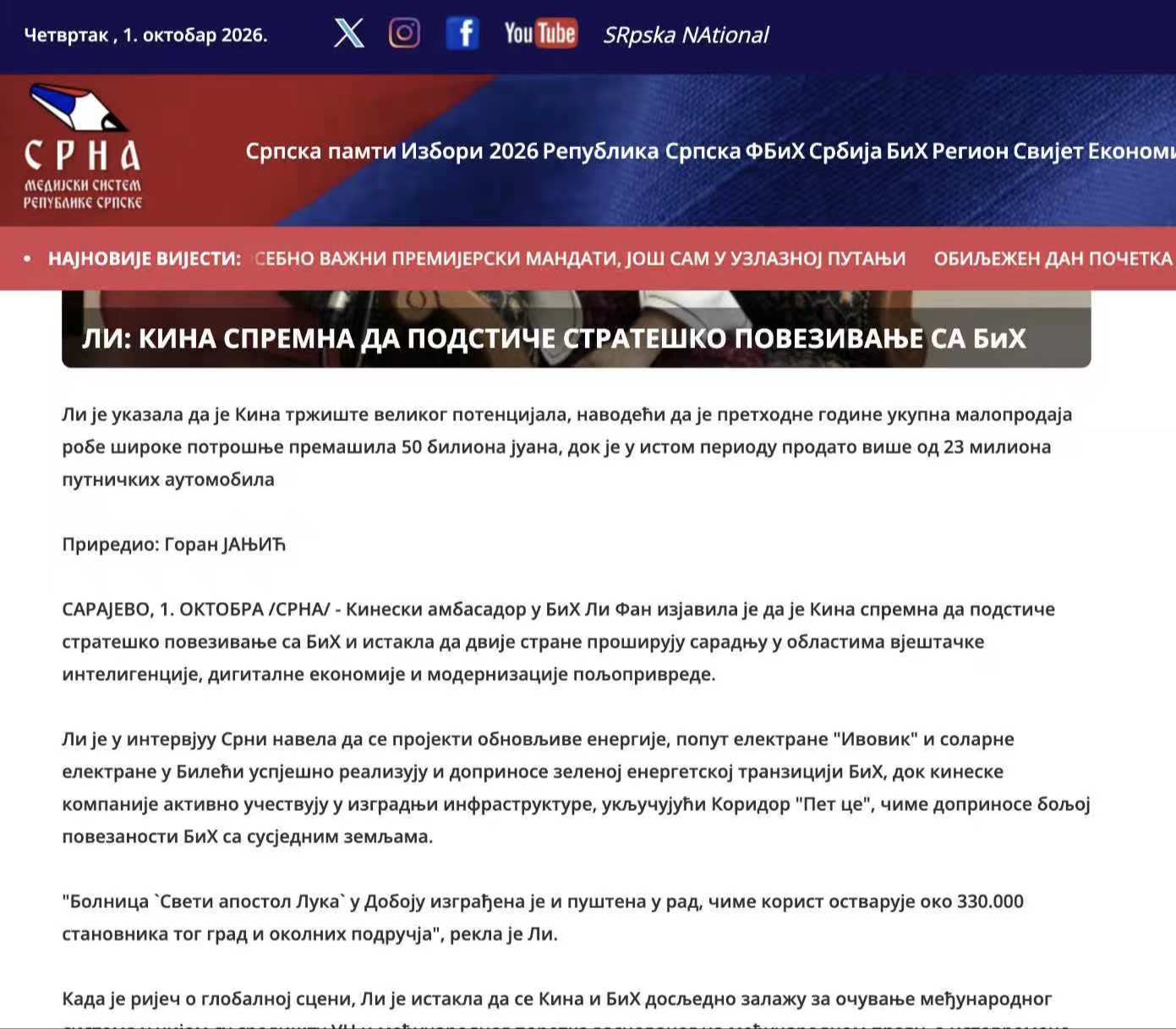
Exclusive Interview with SRNA
Question: China’s Global Governance Initiative has quickly won the support and positive response of many countries and international organizations. In your view, what are the key priority areas on which the initiative focuses?
Ambassador Li: The fruitful outcomes of the GGI in the year since it was put forward fully demonstrate that extensive consultation, joint contribution and shared benefits are what all aspire to, that upholding multilateralism is a universal consensus, and that building a more just and equitable global governance system is a shared expectation. The GGI focuses on five priority areas. First, sovereign equality: all countries, regardless of size, strength or wealth, should participate in, make decisions on and benefit from global governance on an equal footing. We should promote democracy in international relations and increase the representation and voice of developing countries. Second, the international rule of law: the universally recognized basic norms governing international relations, including the purposes and principles of the UN Charter, should be fully, thoroughly and faithfully observed, and international law and international rules should be applied equally and uniformly, with no “double standards” and no imposition of the “house rules” of a handful of countries on others. Third, multilateralism: countries should strengthen solidarity and coordination, oppose unilateralism, and ensure that the United Nations plays its irreplaceable and important role in global governance. Fourth, a people-centered approach: the global governance system should be reformed and improved to ensure that peoples of all countries take part in global governance together and share its fruits. Fifth, action orientation: the resources of all parties should be fully mobilized to deliver more visible outcomes, and practical cooperation should be used to avoid governance gaps and fragmentation.
Question: China, together with Russia, supports multipolarity. To what extent is the world, especially the Western countries, prepared to accept the new reality that “all countries are equal”?
Ambassador Li: In his recent address to the General Assembly, UN Secretary-General António Guterres said that multipolarity takes different forms. One is a fragmented and transactional multipolarity, marked by heightened tensions and growing distrust, fractured markets and fragile institutions, and shrinking cooperation and zero-sum calculations. The other is a networked multipolarity, in which countries are interdependent, with closely linked economic, political, social and technological ties, and multiple centers of influence coexist under a shared architecture of international law and values.
Ambassador Li: China advocates an equal and orderly multipolar world. First, equal treatment: China holds that all countries, big or small, are equal, and calls for increasing the representation and voice of developing countries in the international system. This will not lead to an “absence of the West,” but will promote a positive-sum world. Every country’s voice should be heard, and every country can find its place and play its role in a multipolar landscape. Second, the international rule of law: a multipolar landscape must not be one of disorder, for without rules, one could be “at the table yesterday and on the menu tomorrow.” Major countries should take the lead in honoring credibility and the rule of law and firmly discard inconsistency between words and deeds and zero-sum games. Third, multilateralism: China firmly safeguards the authority and standing of the United Nations and contributes more than 20 percent of the UN regular budget. It has earnestly implemented the Paris Agreement and built the world’s largest clean power generation system. Fourth, openness and cooperation: inclusive economic globalization that benefits all should underpin an equal and orderly multipolar world. Protectionism is no way out, and indiscriminate tariffs produce no winners. “Decoupling and severing supply chains” severs opportunities, and “small yards with high walls” only wall oneself off.
Ambassador Li: An Australian scholar has described China as a “major enabling country.” Looking around the world, China is a market of great potential that combines the two features of being “large” and “new.” According to statistics, in 2025 China’s total retail sales of consumer goods exceeded 50 trillion yuan. In the same year, retail sales of passenger vehicles surpassed 23 million units. In the first half of 2026, both the production and sales of new energy vehicles (NEVs) in China exceeded 7 million units—for every three new cars sold, two were NEVs. On the other hand, scientific and technological innovation is deeply integrated with industrial innovation. Taking AI as an example, in 2025 the scale of China’s core AI industries exceeded 1.2 trillion yuan, with more than 6,200 enterprises. Industries of the future such as intelligent connected vehicles, the low-altitude economy and embodied AI are accelerating their move out of the laboratory. China stands ready to promote strategic alignment with Bosnia and Herzegovina and with Europe, empowering one another and empowering the world.
Question: How can Republika Srpska and the Federation of Bosnia and Herzegovina, and Bosnia and Herzegovina as a whole, contribute to the Global Governance Initiative?
Ambassador Li: China has always firmly respected the sovereignty, independence and territorial integrity of Bosnia and Herzegovina, maintained that Bosnia and Herzegovina’s affairs should be decided by itself, and opposed external interference in its internal governance process. Bosnia and Herzegovina has also, on multiple occasions and through diplomatic notes, reaffirmed its firm commitment to the one-China principle and its support for UN General Assembly Resolution 2758. The two sides’ mutual support on issues concerning each other’s core interests is a true reflection of the GGI’s principle of sovereign equality in China–Bosnia and Herzegovina relations.
Ambassador Li: China and Bosnia and Herzegovina are committed to safeguarding the international system with the United Nations at its core and the international order based on international law. Proceeding always from Bosnia and Herzegovina’s national conditions and the fundamental interests of its people, China calls for resolving differences through inclusive dialogue and maintaining lasting peace and stability in the Western Balkans. It communicates and coordinates with the Bosnian side on such issues as enhancing sustainable development, promoting regional peace and increasing the representation of Global South countries, jointly raising the voice for upholding multilateralism.
Ambassador Li: Relying on high-quality Belt and Road cooperation and the China-Central and Eastern European Countries (China-CEEC) cooperation mechanism, the two countries are translating the vision of the GGI into concrete results. New energy projects such as the Ivovik wind power project and the solar power plant in Bileća are being smoothly implemented, supporting Bosnia and Herzegovina’s green energy transition. The “Sveti Apostol Luka” (St. Apostle Luke) Hospital in Doboj has been completed and put into use, benefiting 330,000 local and nearby residents. Chinese enterprises are actively taking part in building infrastructure such as Pan-European Corridor Vc, promoting connectivity between Bosnia and Herzegovina and its neighbors. The two sides are also expanding cooperation in such fields as AI, the digital economy and agricultural modernization.