
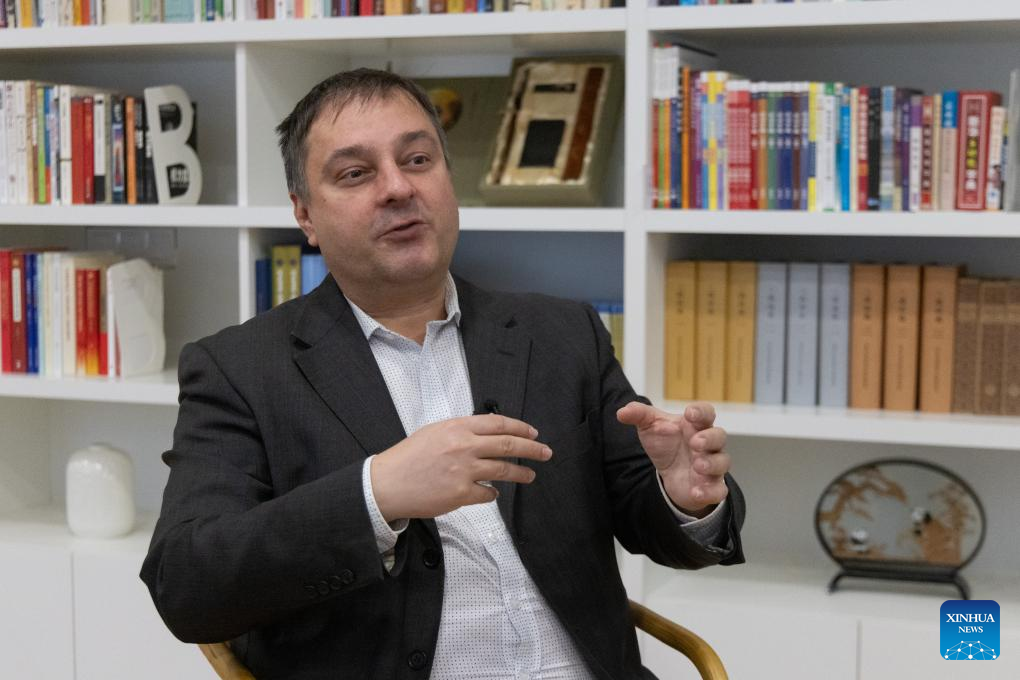
Zoltan Kiszelly, director of the Center of Political Analyses at Hungary's Szazadveg Foundation, speaks during an interview with Xinhua in Budapest, Hungary, Dec. 10, 2024. (Photo by Attila Volgyi/Xinhua)
By Geza Molnar
BUDAPEST, Dec. 31 (Xinhua) -- For Zoltan Kiszelly, director of the Center of Political Analyses at Hungary's Szazadveg Foundation, his first visit to China was a blend of discovery, dialogue, and cultural appreciation.
Invited by the Chinese Academy of Social Sciences, Kiszelly participated in a study tour and conference in late November that left him with a profound impression of China's development, history, and approach to the future.
"It was my first time in China," Kiszelly said in an exclusive interview with Xinhua. The Hungarian expert attended the book launch of Prime Minister Viktor Orban's political director, Balazs Orban, who promotes the Hungarian government's stance on connectivity as a counterpoint to decoupling, de-risking, and anti-globalization.
The journey began in Chongqing, a bustling metropolis and one of the starting points of the China-Europe Railway Express. "It was very impressive to see the logistical hub where goods are assembled and prepared for shipment to Europe, 8,000 kilometers away," he remarked. Standing at the zero-kilometer stone where the trains begin their journey gave Kiszelly a real sense of China's vision for global connectivity.
TECHNOLOGICAL AND CULTURAL MARVELS
Kiszelly's visit to Chongqing showcased the city's dual focus on cutting-edge innovation and ancient heritage. At a robotics company, he observed how technology is being used to tackle dangerous tasks. "It was fascinating to see 21st-century technology in action," he said. "These robots can take over dangerous jobs from people working in hazardous environments."
The cultural experiences were equally striking. "We visited 800-year-old mountain carvings -- monuments of ancient Chinese culture," he shared. "And the nighttime river cruise on the Yangtze, with the city's lights illuminating the skyline, was truly breathtaking."
Kiszelly highlighted the warmth and curiosity of the people he encountered. "We spoke with technicians, engineers, and academics," he explained.
BRIDGING THE PAST AND FUTURE
From Chongqing, Kiszelly traveled to Beijing for a two-day conference at the Chinese Archaeological Museum. The venue itself symbolized China's vision of connecting the past with the future. "The conference juxtaposed 5,000 years of history with discussions about the 21st century," Kiszelly said, reflecting on the depth of Chinese civilization and its ambitious outlook.
The modern infrastructure of Beijing, which hosted both the Summer and Winter Olympic and Paralympic Games, also left a lasting impression. "The scale and organization of the development were remarkable," he said. He also toured the Museum of the Communist Party of China which he described as a compelling narrative of China's journey, presented in an accessible way.
A SHARED FUTURE
Kiszelly noted that the Belt and Road Initiative (BRI) aligns seamlessly with Hungary's Eastern Opening policy. "The term 'all-weather strategic comprehensive partnership' means that the two countries have more in common and want to enhance and embolden their relationship."
He also recalled that Hungary was the first country to recognize the People's Republic of China 75 years ago and the first European nation to join the BRI. "That underlines and shows the long-term relationship between Hungary and China over the past 75 years," he said.
Kiszelly observed that the scale of China's urban development and manufacturing capacity is unmatched. He saw a level of industrial focus and innovation rarely found elsewhere. "It was impressive to see how many people, how many engineers, and how many companies are working for the future."
One word recurred frequently during Kiszelly's interview: connectivity. "With Chinese technology, we can develop our countries and face common threats to mankind. For instance, with China's green technology -- electric vehicles, solar panels, and other renewable innovations -- we can tackle climate change. We get a better environment and better living conditions. This is how the Hungarian government views connectivity."
The work China is putting into building the future represents "a shared future for mankind in a new era," Kiszelly said.