
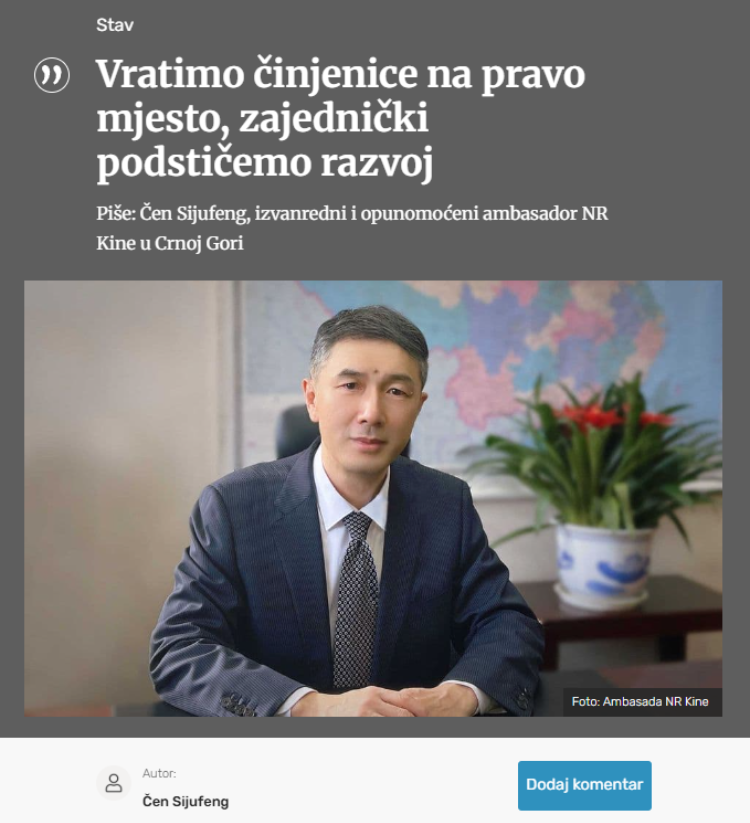
On August 11, 2026, Chinese Ambassador to Montenegro Chen Xufeng published a signed article titled “Setting the Record Straight and Promoting Development Together” in Pobjeda, a leading Montenegrin newspaper. The full text is as follows:
The international situation is currently complex and volatile. Certain countries have repeatedly engaged in geopolitical manipulation, fabricated false narratives, and stoked division and confrontation in public discourse, and wantonly sought to suppress China’s development. Recently, some countries have once again hyped the false claim of so-called “forced labor” involving Uyghurs in Xinjiang, which has long been thoroughly disproved by facts, and arbitrarily placed large numbers of Chinese enterprises in the real economy on unilateral sanctions lists. Meanwhile, some Western media outlets and commentators have deliberately hyped the so-called “production overcapacity” of China in an attempt to smear China’s industrial development and obstruct international economic and trade cooperation. A lie repeated a thousand times remains a lie. It is necessary to set the record straight, clarify the facts, and work with our Montenegrin friends to explore a genuine path toward win-win cooperation.
I. The So-Called “Uyghur Forced Labor” Is a Groundless Political Lie That Distorts Facts and Confounds Black and White
In China today, artificial intelligence, smart agriculture and industrial automation are advancing rapidly. Take cotton farming in Xinjiang as an example: from sowing and field management to harvesting, large-scale mechanization and intelligent, unmanned operations have already been achieved. At a time when technology is so advanced, claims that China needs “forced labor” for large-scale production and cultivation not only defy common sense but are patently absurd.
In fact, China has always attached great importance to protecting the rights and interests of ethnic minorities. The Ethnic Unity and Progress Promotion Law, which formally came into effect this year, has consolidated through national legislation the institutional achievements of equality, unity and common development among all ethnic groups. It safeguards, at the legal level, the rights of people of all ethnic groups to choose their occupations freely, take up employment voluntarily, receive due remuneration for their work, and share in the fruits of development. People of all ethnic groups create better lives through their own hands: labor is dignified, employment offers choices, and livelihoods are secure. This is the truest and most vivid reality in Xinjiang. Today, all people living in poverty in China’s ethnic minority areas have been lifted out of poverty. The combined GDP of China’s five autonomous regions, including Xinjiang, rose from RMB 3.25 trillion in 2012 to RMB 8.66 trillion in 2025. These achievements are powerful proof that China’s policies toward ethnic minorities are about empowerment, not deprivation, and about development, not restriction. By contrast, certain countries loudly claim to “protect minority rights,” yet in practice use unilateral sanctions and trade blockades to crudely prevent products from ethnic minority areas from reaching the world, cutting off local industrial chains, market access and employment opportunities. Under the banner of protecting human rights, they deprive ethnic minorities of their rights to development and employment, as well as their opportunities to achieve greater prosperity. Such political manipulation based on double standards constitutes a blatant violation of human rights.
II. The So-Called “Production Overcapacity” Claim Is Groundless, and Hard Work Should Not Become a Pretext for Suppression
Dynamic adjustments in the global industrial structure and the constant rebalancing of capacity supply and demand are normal features of economic development in all economies. The capacity issue of any single country should not be viewed in isolation as so-called “excess capacity.” In response to smears about so-called “production overcapacity,” a recent position paper released by China’s Ministry of Commerce made clear that the capacity issue should be viewed objectively and in accordance with economic laws, against the backdrop of globalization and in light of global market supply and demand.
Labor is the source of social wealth and human civilization. Yet a distorted phenomenon has emerged in today’s global economy: Some capital interests that have reaped windfall profits from asset bubbles and financial leverage do so with complete ease, only to turn around and blame and smear countries and peoples that produce real goods through diligent work. No just system of values in the world would blame workers for earning lawful income through honest labor. China provides the world with high-quality, cost-effective green and high-tech products. Their competitiveness is underpinned by hardworking and skilled workers, sustained R&D investment and complete industrial chains—not unfair subsidies or so-called “excess capacity.” Politicizing and stigmatizing normal industrial advantages and using state power to suppress market competition will inevitably undermine the security and stability of global industrial and supply chains and harm the common interests of all open economies.
III. Lies Cannot Stop Development, and Hegemony Cannot Block Cooperation
Over the past two decades, China-Montenegro relations have stood the test of time and consistently upheld mutual respect, equality and mutual benefit. A series of infrastructure projects, projects that improve people’s livelihoods and green projects have benefited the Montenegrin people and become examples of practical cooperation between China and Central and Eastern European countries. Global development is now entering a new era centered on new quality productive forces, artificial intelligence, green and low-carbon development, and digital transformation. Montenegro’s commitment to building an ecological state, green development and digital-led growth is highly aligned with China’s development philosophy. China has accumulated mature technologies, complete production capacity and rich experience in AI applications, smart infrastructure, clean energy, green manufacturing and digital industries. These strengths do not constitute so-called “production overcapacity”; they are sources of fresh impetus for the global green and low-carbon transition and for modernization efforts around the world. China and Montenegro enjoy broad prospects for cooperation, and collaboration in emerging fields such as the digital economy and artificial intelligence is gathering momentum.
We oppose trade protectionism carried out in the name of so-called “protection of minorities,” and we also oppose the politicization of normal industrial cooperation. Standing at a new starting point as China and Montenegro mark the 20th anniversary of diplomatic relations, China is ready to work with Montenegro, on the basis of mutual respect, equality and mutual benefit, to deliver more tangible results in practical cooperation across various fields, jointly uphold a fair and just international order, and move together toward a more prosperous and better future.