
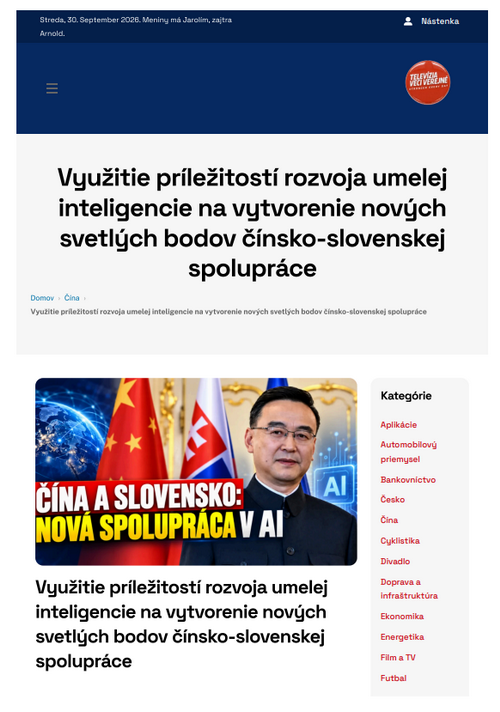
On September 29, 2026, Cai Ge, Chinese Ambassador to Slovakia, published a signed article titled “Seize the Opportunities of Artificial Intelligence Development and Create New Highlights of China-Slovakia Cooperation” in the Slovak magazine Public Affairs. The full text is as follows:
Artificial intelligence (AI) has become a core hallmark of the scientific and technological revolution in the new era and is rapidly moving into every industry and into the daily lives of the general public. In exchanges with friends from all walks of life in Slovakia, several questions of common concern are often raised: Is AI truly safe? Will it be monopolized by a handful of countries and companies, resulting in inequitable access to technology and its dividends? Can the international community develop unified and effective rules to ensure the orderly development of AI?
Objectively speaking, while AI brings enormous development opportunities, drives economic growth and makes people’s lives more convenient, it also comes with many new risks and challenges. How to enable AI to develop steadily, benefit all countries and remain safe and controllable, so that it truly contributes to the common development of the world and safeguards the common security of humanity, is a practical question for both China and Slovakia—and, more than that, a global issue confronting our entire era and the entire international community.
In the face of the new circumstances and challenges in AI development, China has remained committed to the vision of a people-centered approach and AI for good. Balancing accelerated development with security safeguards, China advocates openness, cooperation, mutual benefit and win-win results, and has taken a series of concrete measures to build a fairer, more inclusive and more equitable global AI governance system.
This July, the 2026 World Artificial Intelligence Conference (WAIC) and the High-Level Meeting on Global AI Governance were successfully held in Shanghai, bringing together government representatives, industry experts and delegates from research institutions and universities from more than 100 countries and international organizations to explore pathways for AI development and governance. In his keynote address at the conference, Chinese President Xi Jinping proposed that all countries uphold a people-centered approach and develop AI for the positive and for good, ensure that AI better serves global common development and safeguards the common security of all countries, and work together to build a fair and equitable global AI governance order. These principles are grounded in development realities, pragmatic and feasible, and have charted a clear course for the sound development of AI across the world.
First, we must pursue openness and innovation to strengthen the industrial foundation of AI. China has consistently advocated open-source technology, openness and sharing, and has made every effort to advance AI technological innovation, industrial upgrading and scenario-based application, so that intelligent technologies can truly empower industries and benefit people’s livelihoods. Since fully implementing its national AI strategy in 2024, China has seen strong momentum in its intelligent industries, which continue to drive high-quality economic development. By 2025, China was home to more than 6,200 AI-related enterprises, with its core AI industry exceeding 1.2 trillion Chinese yuan (US$ 170.7 billion) in scale. Emerging sectors such as intelligent computing power, general-purpose large models, intelligent robots, intelligent manufacturing, intelligent driving, high-end chips and the low-altitude economy are rising rapidly, and the overall strength of domestically developed large models firmly places China in the world’s first tier. By the end of 2025, China accounted for more than two-thirds of the world’s total robotics-related patents, demonstrating a marked edge in technological innovation. Today, AI is deeply integrated into the real economy and public services. It is not only helping traditional manufacturing complete digital and intelligent upgrading, but is also widely applied in livelihood sectors such as health care, education, culture and tourism, transport, and urban emergency response, making public services more refined, convenient and intelligent.
Second, we must hold the security bottom line to ensure that AI develops in a controllable and reliable manner. China attaches great importance to the various potential risks and challenges accompanying the rapid development of AI. While pursuing development, we have also focused on security, continuously improving relevant laws and regulations, management systems, application norms and ethical standards to ensure that AI remains safe, controllable and reliable. In recent years, China has successively introduced special provisions on algorithmic recommendation and online content governance, issued the world’s first dedicated regulatory measures for generative AI, and taken the lead in setting the world’s first safety testing standards for AI agents. We have also established dedicated working mechanisms to conduct routine screening and management of AI risks, enabling AI to develop both rapidly and steadily. At the same time, we firmly oppose the attempts of certain countries, in the name of national security, to impose technology blockades and industrial barriers, and reject the one-sided approach of building one’s own security on the insecurity of others. We call on all countries to embrace the vision of common security and jointly safeguard a secure and stable environment for AI development.
Third, we must uphold inclusiveness and mutual learning so that the fruits of AI benefit the whole world. The development of AI should not be a “solo performance” by any single country, but rather a “symphony” of global cooperation. The innovative application of intelligent technologies must not undermine the diversity of world civilizations, still less weaken the cultural distinctiveness of individual countries. The international community should ground itself in the common values of humanity, foster a positive and sound direction for AI development, and use intelligent technologies to narrow the distance among civilizations and promote exchanges and mutual learning, so that AI becomes a bond for greater inclusiveness and consensus. To support the common development of all countries and narrow the digital divide, over the next five years China will provide 5,000 dedicated AI training places for developing countries and, leveraging multilateral platforms such as ASEAN, the African Union, the SCO and BRICS, set up a number of international AI cooperation and application centers. Notably, the World Artificial Intelligence Cooperation Organization (WAICO), the world’s first intergovernmental international organization for AI, has been officially established. In strict observance of the purposes and principles of the Charter of the United Nations, the Organization is committed to equality, inclusiveness and AI for good, and to extensive consultation, joint contribution and shared benefits, and is open to all countries. This is an important, concrete step by China to respond to the aspirations of developing countries and work with the international community to advance AI development and governance; it is also a major milestone in the global development of AI.
Fourth, we must practice multilateralism and improve the global governance system. To promote the sound, long-term development of AI, we must uphold true multilateralism, give full play to the central role of the United Nations, and promote global AI governance rules that are widely recognized by all parties and accommodate the interests of all countries. The international community should strengthen exchanges and cooperation, with a focus on helping developing countries enhance their capacity for AI application and governance, enabling them to keep pace with the intelligent era and preventing new digital divides and inequitable development. As a responsible major country, China has continued to provide public goods, share its experience and offer Chinese solutions for global AI development. We took the initiative to launch the Global AI Governance Initiative, promoted the adoption by the United Nations of a resolution on international cooperation on AI capacity building, led the establishment of WAICO, and supported the deployment of the “Mazu” intelligent meteorological early-warning system in 30 countries. Through these concrete actions, we are contributing to the coordinated development, capacity building and rules-based governance of AI worldwide and continuously improving the global intelligent governance system.
China’s vision, approach and concrete measures for AI development have won broad recognition and high acclaim from the international community. During his visit to China this July, Slovak President Peter Pellegrini explicitly endorsed the set of principles and initiatives put forward by President Xi Jinping at the 2026 WAIC, and the leaders of the two countries reached important consensus on deepening practical AI cooperation and jointly improving the global AI governance system. We are confident that, with the joint efforts of China and Slovakia, AI will become a new highlight and a new growth driver for practical cooperation between our two countries. This will not only further deepen the China-Slovakia strategic partnership, support high-quality Belt and Road cooperation and elevate China-CEEC cooperation, but will also inject fresh vitality into global AI governance. China sincerely welcomes Slovakia’s active participation in multilateral platforms such as WAICO, as we work together to uphold the original aspiration of AI for good, deepen open and practical cooperation, and improve the global governance system, so that AI can better benefit the Chinese and Slovak peoples and the whole world.