
WARSAW, Sept 1 (People's Daily Online) — Representatives of nearly 30 member companies of the Polish-Chinese General Chamber of Commerce (SinoCham) visited the southwestern Polish provinces of Opole, Lower Silesia and Lubusz from Aug 25 to 28. The delegation traveled to Opole, Wrocław, Zielona Góra and other locations, meeting representatives of local governments, chambers of commerce, special economic zones and companies to explore the investment climate, industrial partnerships and supply chain cooperation.
Opole Province was the delegation's first stop. Representatives of the local government, chamber of commerce and Opole University of Technology outlined the region's economic and industrial development and discussed investment cooperation with Chinese companies. A "China Night" networking event was held that evening. Participants included Zuzanna Donath-Kasiura, deputy marshal of Opole Province; Maciej Wujec, first deputy mayor of Opole; Bartosz Ryszka, president of the Opole Chamber of Commerce; and Marcin Lorenc, rector of Opole University of Technology.
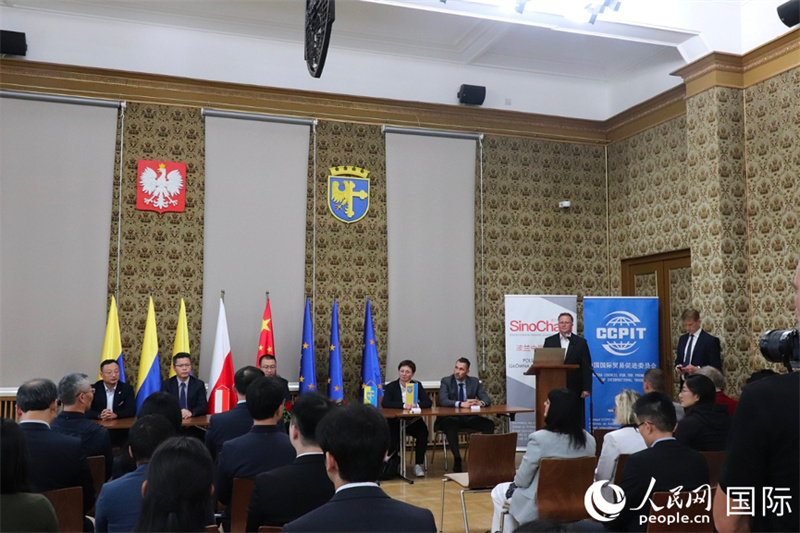
Participants at the meeting. Photo by Yu Limin/People's Daily Online
Donath-Kasiura said Opole was among Poland's most economically dynamic provinces. She said the province placed great value on China's vast market opportunities and economic and trade strength, and hoped to see more cooperation with leading Chinese companies so that more Chinese consumers could learn about and use products from Opole. Wang Jupeng, SinoCham's secretary-general and the representative in Poland of the China Council for the Promotion of International Trade, said Chinese companies had launched a number of projects in Opole and surrounding areas in auto parts, machining, warehousing and logistics. These projects had created local jobs and facilitated exchanges of technology and management expertise. Meanwhile, more local companies were showing interest in and seeking to enter the Chinese market. The two sides' complementary strengths in branding, distribution channels and technology were gradually being realized, while local-level economic and trade exchanges helped companies better understand market conditions and the investment environment.
In Lower Silesia Province, the delegation met local economic and trade organizations to discuss electronics manufacturing, modern services and other fields, and held a "China Night" event in Wrocław. Mariusz Żebrowski, vice-president of the Lower Silesian Chamber of Commerce, said China's rapid economic and business development had also created new opportunities for Poland, particularly Lower Silesia. He described the region's diverse industrial structure, highlighting technology services, industry, logistics and warehousing, and expressed the hope that face-to-face business exchanges would help identify further opportunities for cooperation.
Teodor Stępa, vice-president of the management board of the Wałbrzych Special Economic Zone, said he looked forward to more Chinese companies establishing operations in the zone, which would help deepen their partnerships with the European market. The zone will mark its 30th anniversary next year and hopes to use the occasion to broaden cooperation and attract more Chinese investment, while supporting companies in investment negotiations, contract signing and other processes.
Lubusz Province was the final stop. The delegation discussed investment cooperation with the local government, special economic zones and other organizations, and held a "China Night" event in Zielona Góra. Hubert Harasimowicz, deputy marshal of Lubusz Province, welcomed the Chinese delegation and outlined Chinese investment in the region. He said Chinese companies had already invested in both the north and south of the province. Zielona Góra's proximity to Germany and well-developed roads and other infrastructure provided favorable conditions for logistics and transport. Citing the Chinese saying that "the deeper a tree's roots, the better it can withstand wind and rain", he likened China-Poland cooperation to a deeply rooted tree. He hoped Lubusz would leverage its location linking Germany and other European markets to serve as a bridge for Chinese companies entering Europe.
During discussions at the Kostrzyn-Słubice Special Economic Zone, Magdalena Hilszer, vice-president of its management board, said the zone was home to more than 480 companies, with cumulative investment of nearly 20 billion zlotys and over 27,000 jobs created. She said the zone offered more than tax incentives: it aimed to be a partner throughout the investment process. By connecting investors with local governments, universities, research institutes, vocational schools and business partners, it provided support with site selection, policy advice and local cooperation.
Hilszer said western Poland had a well-developed industrial base, with established sectors including machinery manufacturing, automotive production, metalworking, plastics, chemicals, wood processing and papermaking. It was also developing advanced manufacturing, automation, digital technologies, research and development, green technologies, and defense and dual-use production. For Chinese companies, she said, Poland could serve not only as a manufacturing location but also as a base for technology, R&D and logistics serving the EU market. The zone could support new factories, expansions of existing facilities, technological upgrading, R&D projects and modern business services, with support available for up to 15 years.
The "China Night" events held in the three locations during the visit brought together representatives of Chinese companies operating in Poland, including Bank of China, the Industrial and Commercial Bank of China, China Telecom, Power Construction Corporation of China (POWERCHINA) and BYD, as well as local chambers of commerce, special economic zones and other organizations. The two sides discussed market entry, industrial collaboration and logistics services in light of the practical needs of companies investing and operating in Poland.
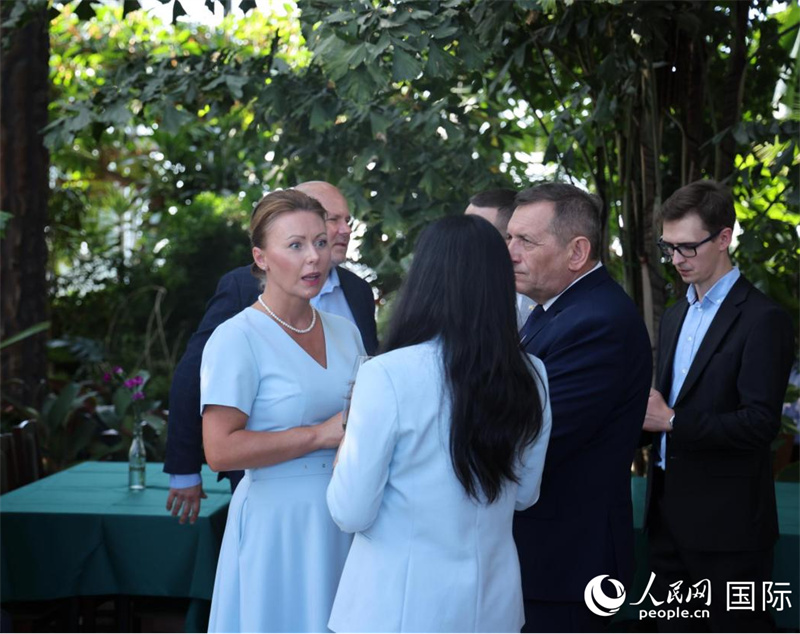
Guests exchange views at the event. Photo by Yu Limin/People's Daily Online
On July 23, Bank of China launched the "Global Gateway Cooperation Alliance" in Shenzhen. Co-founded by 10 institutions, it offers integrated financial, logistics, legal and accounting services to support companies' overseas development. During the visit, Bank of China (Europe) S.A. Poland Branch worked with SinoCham on organization and business matchmaking in line with its head office's initiatives to help companies expand overseas. This brought financial services directly to companies undertaking investment visits and pursuing economic and trade cooperation.
During the visit, SinoCham also promoted the fifth China International Supply Chain Expo (CISCE). Under the theme "Connecting the World for a Shared Future", the fifth expo will feature six supply chains — Digital Technology, Advanced Manufacturing, Green Agriculture, Healthy Life, Smart Vehicle and Clean Energy — and a Supply Chain Services exhibition area. The delegation also visited a Nutricia factory, where it learned about production processes, quality control and R&D in infant and young child nutrition and medical nutrition formulations, gaining a deeper understanding of the technological sophistication of Poland's food industry.
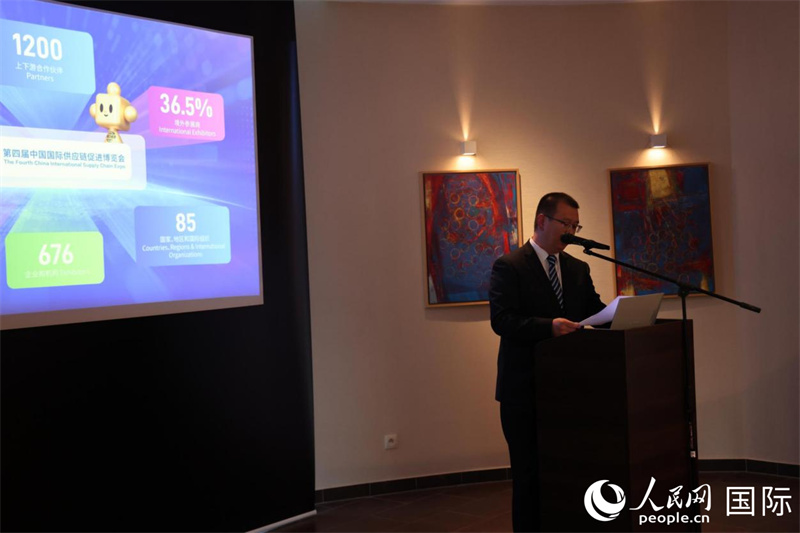
Wang Jupeng, the China Council for the Promotion of International Trade's representative in Poland, introduces the fifth China International Supply Chain Expo. Photo by Yu Limin/People's Daily Online
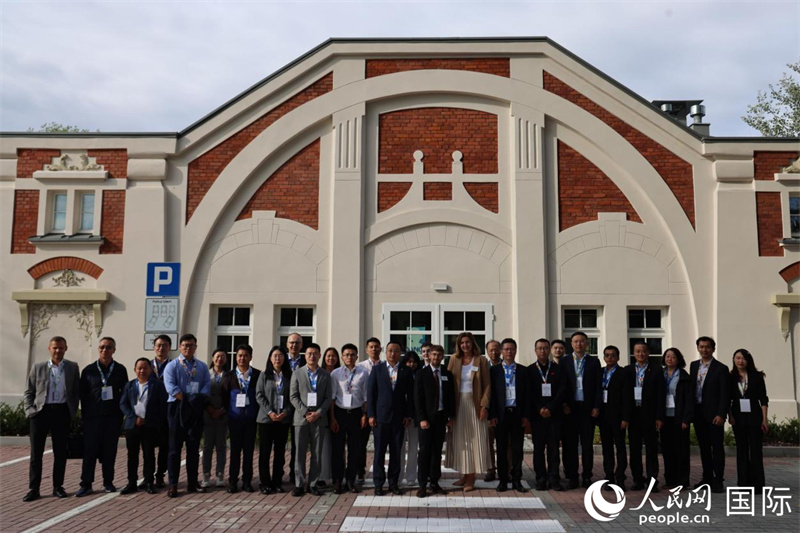
The delegation poses for a group photo after visiting the Nutricia factory. Photo by Yu Limin/People's Daily Online
The visit involved local governments, chambers of commerce, special economic zones, companies and industry organizations. The two sides identified a number of promising leads for follow-up on industrial cooperation, investment projects and market expansion. SinoCham said it would continue to use business visits, "China Night" events, investment presentations, business matchmaking and CISCE to create more opportunities for face-to-face exchanges and practical cooperation between Chinese and Polish companies. It would help the two sides build on their complementary strengths and achieve mutual benefit across a wider range of fields and at a deeper level, while exploring new forms of engagement and contributing the business community's efforts to the sustained and sound development of China-Poland economic and trade relations.